
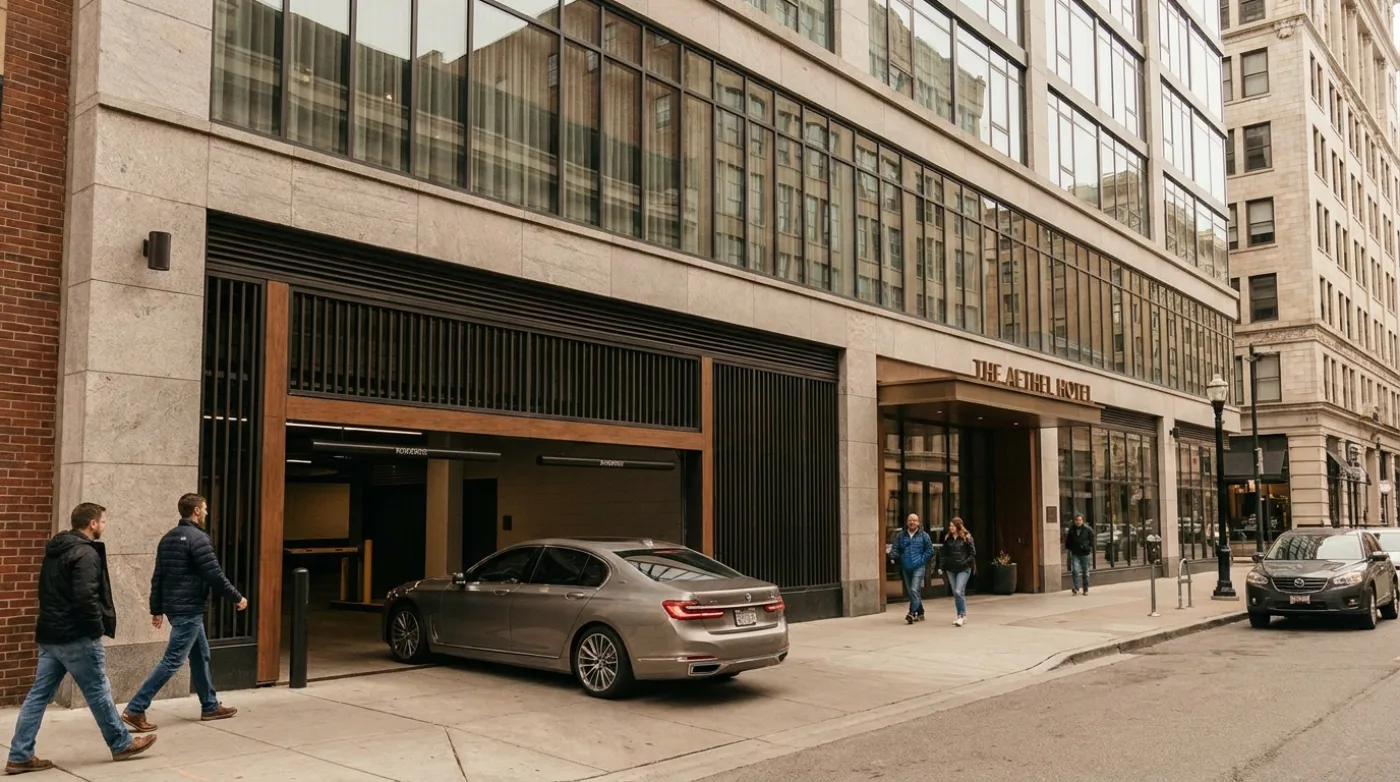
Gated parking uses a barrier arm and ticket or card reader to physically stop every car until it pays or is authorized. Gateless parking removes the barrier and moves control into software, using QR code payments and license plate recognition (LPR) to match each vehicle to a paid session or permit. Both collect revenue. They differ sharply in what they cost to run and how they feel to use.
How each system actually works
In a gated system, the barrier is the point of control. A car arrives, takes a ticket or taps a credential, the arm lifts, and the same sequence repeats in reverse on exit. Nothing happens until the hardware cooperates.
In a gateless system, the lot is open and control is digital. A camera reads the plate on entry, the driver pays by scanning a QR code or is matched automatically to a permit or reservation, and enforcement happens against the plate rather than the barrier. The car never has to stop at a machine.
Side-by-side comparison
| Factor | Gated (barrier + ticket) | Gateless (QR + LPR) |
|---|---|---|
| Access control | Physical barrier arm | Software match to plate or payment |
| Upfront hardware | High (arms, lanes, pay stations) | Low (cameras, signage) |
| Ongoing maintenance | Recurring service contracts, parts | Minimal; mostly software |
| Failure mode | Blocks entry or lets cars in free | Degrades gracefully; lot stays open |
| Throughput at peak | Limited by lane and arm cycle | No queue at a barrier |
| Guest effort | Take ticket, find it later, pay at machine | Scan and pay, or drive straight in |
| Enforcement | Tied to the gate | Plate-based, works lot-wide |
Where the costs really differ
The purchase price favors neither side decisively; the operating cost is where they diverge. A barrier arm is a mechanical device sitting outdoors, exposed to weather, bumpers, and impatient drivers. Ticket printers jam, pay stations freeze, and every failure is a service call. Gateless hardware is smaller, has fewer moving parts, and when a camera has a bad day the lot keeps running instead of physically locking up.
Labor follows the same pattern. Gates create work that never appears on the equipment invoice: refilling ticket stock, clearing jams, and handling the guest stuck at a barrier at midnight with a card that will not read. Gateless systems move those interventions into a dashboard.
Which one should you choose?
Choose gated if you run a very high-volume, transient-heavy facility where a physical barrier is genuinely the simplest way to guarantee payment before exit, and you have staff on hand to service it.
Choose gateless if you run a hotel, surface lot, garage, or mixed-use property where guest experience matters, downtime is expensive, and you would rather manage parking from a screen than from a service truck. For most of these operators, gateless is now the lower-cost, lower-friction option.
The honest takeaway: gates are not obsolete, but for the majority of hotels and surface lots they solve a problem that software now solves better, without billing you for maintenance and downtime in perpetuity.
Frequently asked questions
OpenSpot is a free QR and LPR parking platform for US operators.
Follow on LinkedInKeep reading

NYC Parking Software: The Complete Guide for Garage and Lot Operators
New York parks differently from every other city. Attendant operations, DCWP rate filing, digital claim checks, compliant signage, and the Manhattan Resident Parking Tax Exemption. Here is everything NYC operators need to know.
How a 10-Space Lot Makes $1,500/Month With No Booth, No Gate, No Staff
A 10-space lot in a weekend town can clear $1,500/month or more. here's the math, and why the lots that look too small to bother with are often the ones leaving the most money on the pavement.
The Real Cost of Parking Software: Why OpenSpot Charges $0 in SaaS Fees
The price on a parking software contract is almost never the price you pay. Here is every line item legacy platforms don't quote you up front, and how OpenSpot compares.