
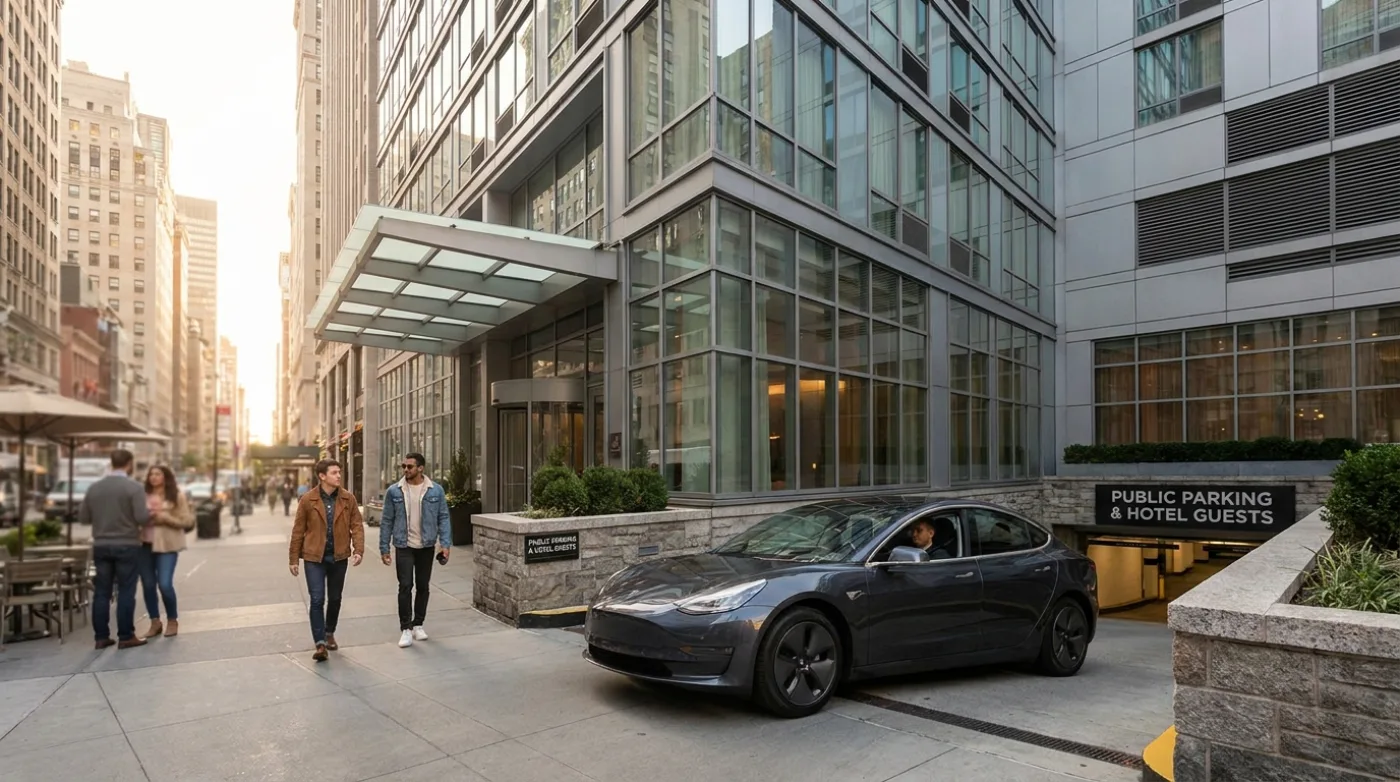
If you've looked into modern parking systems, you've run into the acronym LPR, license plate recognition (sometimes called ANPR, for automatic number plate recognition). It's pitched as the technology that lets you run a lot with no gates and no tickets. That's true, but the marketing usually skips the part where you understand how it actually works. Here's the plain-English version.
The one-sentence version
A camera photographs the back (or front) of every car, software finds the license plate in the image, reads the characters, and matches that plate against a list of who has permission to be there. "Permission" in practice means any of these: the driver paid for a session, they hold a monthly permit, they're a registered hotel guest, or they're on a validation list you set up. That's the whole idea.
The actual workflow, step by step
Capture. A camera at the entrance or covering the lot takes an image of each vehicle as it arrives.
Detection. Software locates the plate within the image, distinguishing it from bumper stickers, frames, and reflections.
Recognition. Optical character recognition converts the pixels of the plate into actual text, like "7XYZ123," plus the state or region.
Matching. That plate string is checked against your records: Did this car pay? Do they have a monthly permit? Are they a registered guest?
Action. Based on the match, the system grants access, starts a parking session, charges the card on file, or flags the vehicle for enforcement.
All of this happens in well under a second, which is what makes a gateless, ticketless lot possible: the car simply drives in.
Each step has a failure point. The camera can miss the capture if the angle is wrong or the lighting is poor. The OCR can misread a character on a dirty or damaged plate. The match can fail if the plate isn't in your system yet, which is common with first-time visitors. A well-designed system handles all three gracefully: re-attempting the read, routing unmatched plates to a fallback QR payment flow, and logging exceptions for review rather than hard-failing the transaction.
What an LPR parking system is made of
People say "LPR system" as if it were a single product. It's four things working together, and only one of them is a camera.
The camera. A fixed unit covering an entrance, an exit, or a stretch of the lot. Purpose-built plate cameras differ from ordinary security cameras in shutter speed and infrared illumination, which is why a general CCTV camera pointed at a driveway rarely produces usable reads.
The recognition software. The model that finds the plate in the frame and turns it into text. This is the part that has improved most in the last decade, and it is usually not the part that fails.
The parking platform. The system that knows your rates, your sessions, your permit holders, and your validations. A plate string is meaningless until something matches it to a record. This is the actual product; the camera is a sensor feeding it.
The exception path. Every LPR deployment needs an answer for the car it cannot match, which on a public lot is most first-time visitors. Usually that answer is signage with a QR code.
Operators who evaluate LPR by camera specs alone tend to end up with accurate reads and no way to charge for them. The matching layer is where the revenue is.
How LPR handles payment
This is the question most operators actually have, and there are two models.
Plate-entered payment. The driver parks, scans the sign or opens your payment page, enters their plate, and pays for a duration. LPR's job is verification: it reads plates in the lot and checks each one against the list of sessions that were paid for. Cars that paid are fine. Cars that didn't are exceptions. This works on any open lot, needs no account, and handles a first-time visitor on day one.
Plate-on-file auto-charge. The driver registers their plate and a card once. After that, entry opens a session automatically, exit closes it, and the card is charged for the actual duration. No scanning, no phone, nothing to do. This is what people mean when they describe LPR as "drive in, drive out" — and it only works for drivers who have registered, which makes it a fit for permit holders, monthly parkers, and repeat guests rather than walk-up transient traffic.
Most real lots run both: auto-charge for the people you know, QR payment for the people you don't. The mistake is picking one and pretending the other population doesn't exist.
LPR for contract parking, permits, and visitor access
Monthly and contract parking is where LPR pays for itself fastest, because the plate replaces a credential.
A permit holder normally carries something: a hangtag, a fob, a sticker, a card. Every one of those can be lost, shared, forgotten, or handed to someone who no longer works there. A plate can't be handed over, and it doesn't need to be issued, mailed, or replaced. You add the plate to the permit and the system knows the car.
That changes a few operational things:
- Multi-vehicle permits become trivial. A tenant with two cars registers two plates against one permit instead of arguing about a second hangtag.
- Visitor access becomes a time-boxed authorization rather than a physical object. A host adds a plate for an afternoon, a weekend, or a date range, and it expires on its own with nothing to collect afterward.
- Reservations attach the plate to the booking, so the car is recognized on arrival without anyone checking a confirmation email.
- Turnover stops leaking revenue. When someone moves out, you remove the plate. There is no fob still circulating in a drawer somewhere.
The one thing this demands is a way for people to update their own plates. Cars get sold, leased, and replaced constantly, and if every plate change requires an email to the property manager, the list goes stale and your exception queue fills with legitimate parkers.
LPR enforcement: what happens when a car doesn't pay
An unmatched plate is not a violation. It's an exception, and the difference matters.
A car can be unmatched because the driver hasn't paid yet, because they're still walking to the sign, because they mistyped a character, or because the read was wrong. Enforcement that treats every unmatched plate as an instant violation generates disputes you will lose and guests you won't see again.
A workable sequence looks like this:
- Grace window. A few minutes between the read and any action, so someone who just parked has time to pay.
- Re-check. The plate is matched again after the window, and against near-miss variants, so a single misread character doesn't create a false violation.
- Evidence. An unmatched car produces a timestamped image of the vehicle and plate. This is the whole basis of any notice you issue, and it's the reason plate photos matter more than plate strings.
- Action. Depending on your property and jurisdiction, that becomes a notice on the windshield, a mailed notice, a charge to a plate already on file, or an entry on a tow list.
Two honest caveats. First, mailing a notice requires looking up a registered owner from a plate, and access to that lookup varies by state and by whether you're a public or private operator. Second, the number that matters is not violations issued, it's violations collected. An enforcement program that issues a hundred notices and collects on twelve is a rounding error with extra steps.
For most private lots, the more valuable framing isn't punishment. It's that visible, consistent enforcement is what makes voluntary payment normal. Lots with no enforcement don't have a violation problem; they have a payment-rate problem, and it's usually worse than operators think.
What makes accuracy good or bad
LPR accuracy isn't a single number; it's the result of physical conditions and software quality together. The things that matter most:
Camera placement and angle. A plate photographed straight-on at a sensible height reads far better than one shot from a steep angle.
Lighting. Good systems use infrared illumination so they read plates at night and in glare, not just in daylight.
Plate condition and variety. Dirty plates, novelty frames, and unusual out-of-region formats are where weaker systems stumble.
Software quality. Modern recognition models handle messy real-world images far better than the rigid systems of a decade ago.
The technology is mature. The installation decisions are where projects succeed or fail.
What LPR costs for a small lot
The old answer was that LPR was for garages with a capital budget, which is why most ten- to fifty-space lots never looked at it. The cost lives in three places: the camera hardware and its installation, the recurring software, and the ongoing maintenance of an outdoor device.
The structural question is whether that hardware arrives as a capital purchase or an operating expense. OpenSpot's enterprise LPR option bundles hardware, installation, and maintenance into a managed monthly subscription with no upfront hardware cost, which is what makes it viable at small-lot scale. The full cost comparison covers how that stacks up against gate hardware and per-space SaaS.
Worth saying plainly: a small lot does not have to start with LPR. A QR sign costs the price of the sign, collects revenue the same afternoon, and gives you a real payment-rate number. Adding cameras once you know what the lot actually earns is a better sequence than buying hardware to find out.
What about privacy?
It's a fair question, and the answer is about policy as much as technology. Responsible operators capture only what they need to run the lot, retain plate data only as long as it serves a clear operational purpose, and follow the data-protection rules that apply in their region. LPR for parking is about matching a car to a paid session, not building a profile of where people go.
The takeaway
LPR isn't futuristic and it isn't magic. It's a well-understood pipeline (capture, detect, read, match, act) that, installed thoughtfully, lets a parking lot run itself without gates or tickets. The interesting questions aren't whether it works. They're where you put the cameras and how you pair it with the rest of your parking management software.
Frequently asked questions
OpenSpot is a free QR and LPR parking platform for US operators.
Follow on LinkedInKeep reading

NYC Parking Software: The Complete Guide for Garage and Lot Operators
New York parks differently from every other city. Attendant operations, DCWP rate filing, digital claim checks, compliant signage, and the Manhattan Resident Parking Tax Exemption. Here is everything NYC operators need to know.
How a 10-Space Lot Makes $1,500/Month With No Booth, No Gate, No Staff
A 10-space lot in a weekend town can clear $1,500/month or more. here's the math, and why the lots that look too small to bother with are often the ones leaving the most money on the pavement.
The Real Cost of Parking Software: Why OpenSpot Charges $0 in SaaS Fees
The price on a parking software contract is almost never the price you pay. Here is every line item legacy platforms don't quote you up front, and how OpenSpot compares.